

The Hidden Profit Killer in Every Shipment
You’ve negotiated a great price with your custom bag manufacturer in China, the quality is excellent, and your customers are eager to buy. But when the customs broker sends you the final duty bill, your profit margin takes an unexpected hit. Import tariffs on bags from China can range from 0% to over 20%, depending on the product’s material, classification, and your country’s trade policies. Learn to navigate these waters, and you can save thousands of dollars per container — legally and transparently.
Reducing customs duties on handbags doesn’t require evasion or risky shortcuts. It requires a deep understanding of Harmonized System (HS) codes, free trade agreements, customs valuation rules, and shipment structuring. This guide walks you through each strategy, providing concrete examples specific to the bag industry. Whether you are importing canvas tote bags, vegan leather cosmetic pouches, or designer nylon backpacks, these techniques will help you cut costs and stay compliant.

Master the HS Code: Your First Line of Defense
The single most powerful tool for reducing import tax on handbags from China is the correct HS code classification. The HS code determines the duty rate applied to your goods. A one‑digit error can double your tariff. Handbags, shopping bags, cosmetic bags, and backpacks all fall under different codes, often with dramatically different duty rates.
| Product Type | Common HS Code Range | Possible US Duty Rate | Notes |
|---|---|---|---|
| Handbags (leather or composition leather) | 4202.21 | 10% — 20% | Often higher; material matters |
| Canvas tote bags / shopping bags | 4202.92 | 6.8% — 17.6% | Cotton vs. man‑made fibers differ |
| Cosmetic bags with outer surface of textile | 4202.92 | Up to 17.6% | Lining material may influence |
The lesson is clear: never let the factory or a generic broker assign your HS code without review. Provide a detailed handbag tech pack template that specifies every material, so a classification specialist can determine the single best code. For example, a bag with an outer surface of plant‑based vegan leather may be classified differently from a traditional PU bag, potentially reducing the rate.
Three Classification Strategies That Legally Lower Duties
Material‑Driven Re‑Classification
If your bag has an outer surface made of 55% cotton and 45% polyester, it might be classified under cotton (potentially lower duty) or man‑made fibers, depending on your country’s General Rules of Interpretation. Sometimes a slight adjustment in material composition — without harming quality — can shift the classification to a lower‑duty bracket.
Structural Subheading Differentiation
A “handbag” is not always a handbag for customs purposes. A bag designed to be carried by hand or over the shoulder is a handbag; a bag with a specifically shaped interior to hold makeup is a “vanity case” (4202.11). A custom cosmetic bag that is primarily a pouch with no internal organizer might be classified differently than one with a structured brush holder and mirror. Design intent, documented in your tech pack, supports your classification choice.
Component Separation
If you import a bag with a detachable strap, some customs rulings allow the strap and the bag body to be classified separately — potentially moving a portion of the product into a lower‑duty category. This requires precise invoicing and packing, but it is a fully legal technique when the components are genuinely separable articles.
Leverage Free Trade Agreements and Preferential Programs
While China itself does not have a free trade agreement with the United States, numerous regional and bilateral trade pacts can dramatically lower handbag import duties. The Comprehensive and Progressive Agreement for Trans‑Pacific Partnership (CPTPP) includes key Asian manufacturing hubs. ASEAN‑China Free Trade Area certificates can benefit importers in member countries. The EU‑Vietnam Free Trade Agreement has made Vietnam an alternative sourcing location for brands seeking to avoid Chinese tariffs altogether.
For US importers, a crucial program is Section 321 de minimis entry. Shipments valued at USD 800 or less per person per day can enter the US completely duty‑free and with minimal paperwork. By structuring smaller, more frequent shipments instead of one large container, you can legally eliminate the customs duty on a significant portion of your inventory. This is especially powerful for direct‑to‑consumer brands or for fulfilling small wholesale orders directly from your factory in Guangzhou.
European importers can benefit from Inward Processing Relief (IPR) in certain countries: import materials duty‑free, manufacture the bags within the EU, and then pay duty only on the finished product — often at a lower rate. While this requires an EU manufacturing step, it can be combined with value‑added finishing on imported semi‑finished bag bodies.
Customs Valuation: Legally Reduce the Taxable Value
Customs duty is calculated as a percentage of the transaction value — essentially the price you paid for the goods, plus certain adjustments. The key is to ensure that you do not overpay duty by including non‑taxable elements in the declared value.
- Separate freight and insurance: Always ask your factory to invoice on a Free on Board (FOB) basis, showing the ocean or air freight and insurance as a separate line item. Duty is generally assessed on the FOB value, not the CIF value, in most countries. Simply separating these charges on the commercial invoice can reduce the dutiable value by 10–15%.
- Exclude design and development costs: If you paid separately for the design, tech pack, or sampling, these are not part of the production transaction value and should not be included in the customs value. Keep these invoices separate, as tech pack creation is a service, not goods.
- Deduct post‑importation costs: Any assembly, maintenance, or technical assistance performed after importation should be excluded from the declared value.
- Never undervalue: Deliberately under‑declaring the price is customs fraud, leading to severe penalties, seizure of goods, and blacklisting. The strategies here focus on legal exclusions, not dishonesty.
Shipment Structuring and Duty‑Efficient Logistics
How you ship matters as much as what you ship. Consolidating 10,000 bags into one container may reduce freight cost per unit, but it guarantees a large single‑day customs entry that attracts full duty. An alternative strategy is to split the shipment across multiple days or consignees, keeping each entry under the Section 321 USD 800 threshold (for the US) where possible. Even outside the US, smaller shipments may qualify for simplified clearance procedures or lower flat‑rate duties.
Working with a licensed customs broker who understands bag classifications can unlock additional savings. For example, certain ports have “drawback” programs where you can reclaim a portion of the duty paid if you later re‑export the goods. If your bags are eventually sold to a customer in another country, duty drawback can return significant capital.

Essential Documentation and Compliance That Prevents Penalties
Incomplete or incorrect documentation is the fastest way to have your shipment held, inspected, and assessed at the highest possible duty rate. Beyond the commercial invoice and packing list, be prepared to provide:
- Certificate of Origin (if claiming a preferential rate under an FTA).
- Material composition sheets with percentages (essential for textile‑based bags).
- Lab testing reports for any materials that might contain restricted substances, ensuring your bags are REACH and Prop 65 compliant. A customs hold due to chemical safety concerns can erase all your duty‑saving efforts.
- Supplier affidavit confirming the construction process and origin of all components.
Keeping these documents organized also makes a factory audit smoother, demonstrating that your manufacturer has the systems in place to support compliant international trade.
How Your Chinese Factory Can Help Reduce Your Tariff Bill
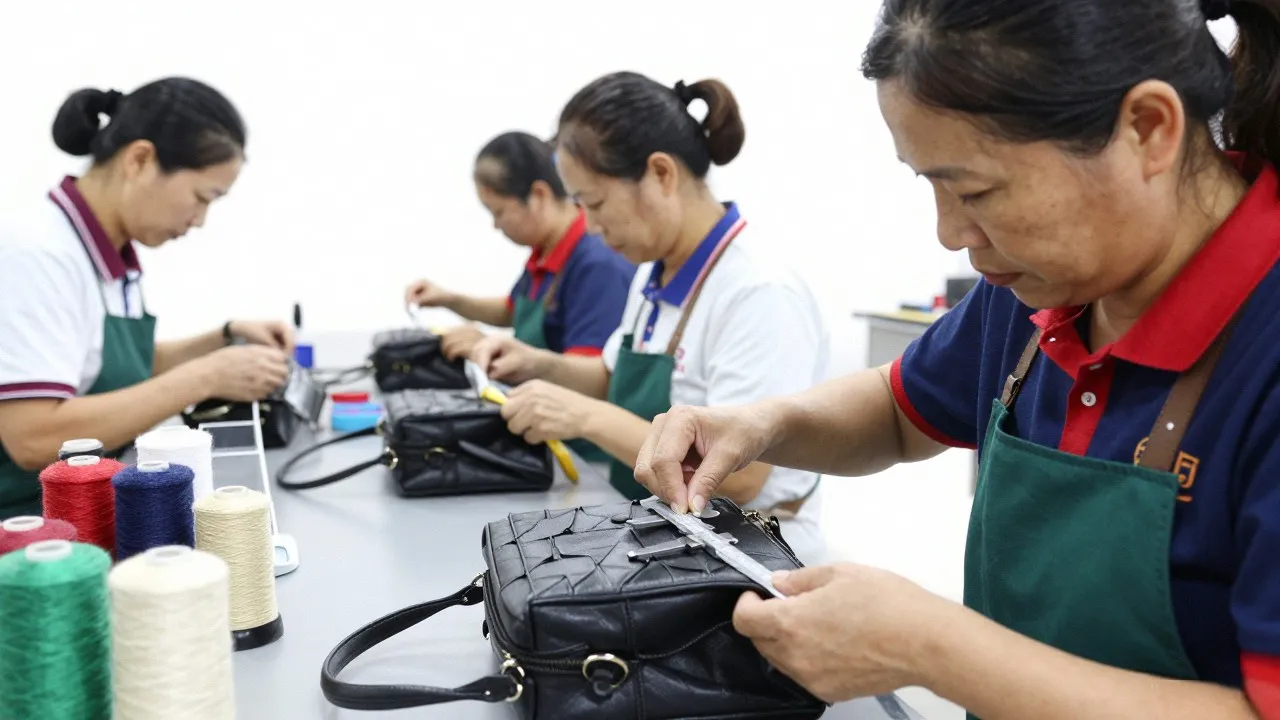
Your manufacturing partner in Guangzhou is not just a producer — they are a critical ally in reducing import duties on bags from China. An experienced factory will suggest minor design adjustments that can trigger a more favorable HS classification without altering the product’s market appeal. They can provide detailed zipper and hardware specifications that support your classification arguments. And they can separate your order into multiple invoices designed to optimize customs entry values.
When touring a potential factory, ask to see their export documentation history. A factory that regularly exports to the EU and the US will understand the paperwork nuances that save you money. This is one more reason to choose a factory like GZ Dreamway, which has been shipping compliant handbags, wine totes, and promotional bags to over 20 countries since 2008.
Start Saving on Your Next Shipment Today
Reducing tariffs and duties when importing bags from China is a discipline, not a one‑time fix. Master your HS codes, leverage every available free trade agreement, structure your shipments intelligently, and maintain flawless documentation. These steps together can reduce your effective duty rate by half or more — turning what was once a cost center into a competitive advantage.
At GZ Dreamway, we support our clients not only with premium custom bag manufacturing but also with the documentation and logistics insights that keep your landed costs low and predictable. Let’s review your current product line and identify where duty savings are waiting.
Ready to Cut Your Import Duties?
Contact us for a free duty‑savings analysis. We’ll review your current bag designs, suggest optimal HS classifications, and connect you with our trusted customs partners.
✅ Confidential • No obligation • Actionable recommendations
Customer Reviews107 Reviews