
7-Stage Leather Bag Quality Control Checklist: A Factory-Side Walkthrough
A leather handbag can pass our line on Friday and still come back in October. We learned this the hard way in 2014, so every order now runs through the same 7-stage chain — leather at the door to container sealed. This is what that chain looks like on our Huadu floor, written for sourcing teams who want a checklist they can defend in a Friday review.
Quick Answer: What Leather Bag Quality Control Checklist Covers
A working leather bag quality control checklist for OEM/ODM orders runs as a 7-stage chain. Skip one, and a "passed" order becomes a return spike three months later — our default from 200 units up. This leather bag quality control checklist reflects our 2026 floor practice in Huadu.
- What it covers: incoming material, cutting, stitching, edge paint, inline, final, pre-shipment AQL
- Why a chain: upstream prevention stops defects before value is added
- AQL in plain English: AQL 2.5 is a sampling limit, not a defect allowance
- When the chain fails: incoming or inline defects only show up three months in
Still picking a factory? Our top leather bag manufacturers guide walks through how QC depth varies by supplier.
Why a 7-Stage Chain Beats a Single Final Check
Most factories only run a final pass
Walk into a tier-2 bag factory in Huadu at 5pm on a Friday and you will see the same thing we used to do: someone strolls the line, picks out the obvious bad units, writes "QC passed" on the batch card. It feels like a system. It is not.
By the time a defect shows up at final, you have already paid to cut it, stitch it, paint it, and pack it. The math does not work out.
The number that changed how we run the floor
Eight years ago, we pulled every return ticket for a year. Hardware failures, color bleed, broken seams, torn linings. 70% were visible upstream — if anyone had looked. They were not looked for, because the check was at the end of the line.
Today the same exercise, last year's lot: under 9%. Same line, same order. The difference is that staff now check at stages 1, 3, 5, 7 — not at the door.
A real OEM case, not a stock photo
A US brand came to us in 2022 after their previous factory shipped 800 units that all passed a single final inspection. Six weeks later, 18% of the lot was returned — D-rings had rusted. The previous factory did not run 100% incoming salt spray on hardware. We do. We pulled the lot, replaced the supplier, re-shipped. That gap is what the chain is built to close.
What changes when the chain moves upstream
When the incoming leather fails color fastness, the lot goes back before it ever reaches the cutting table. When a batch of D-rings rusts at hour 20 of the salt spray, the line is held before the hardware is sewn in. Each stage removes one failure mode from the rest of the chain.
Our floor rule: AQL 2.5 by default (tighten to 1.0 for premium buyers), FAI on every new order, and a written CAPA on every Critical. None of this is unique to us. It is just what the work requires.
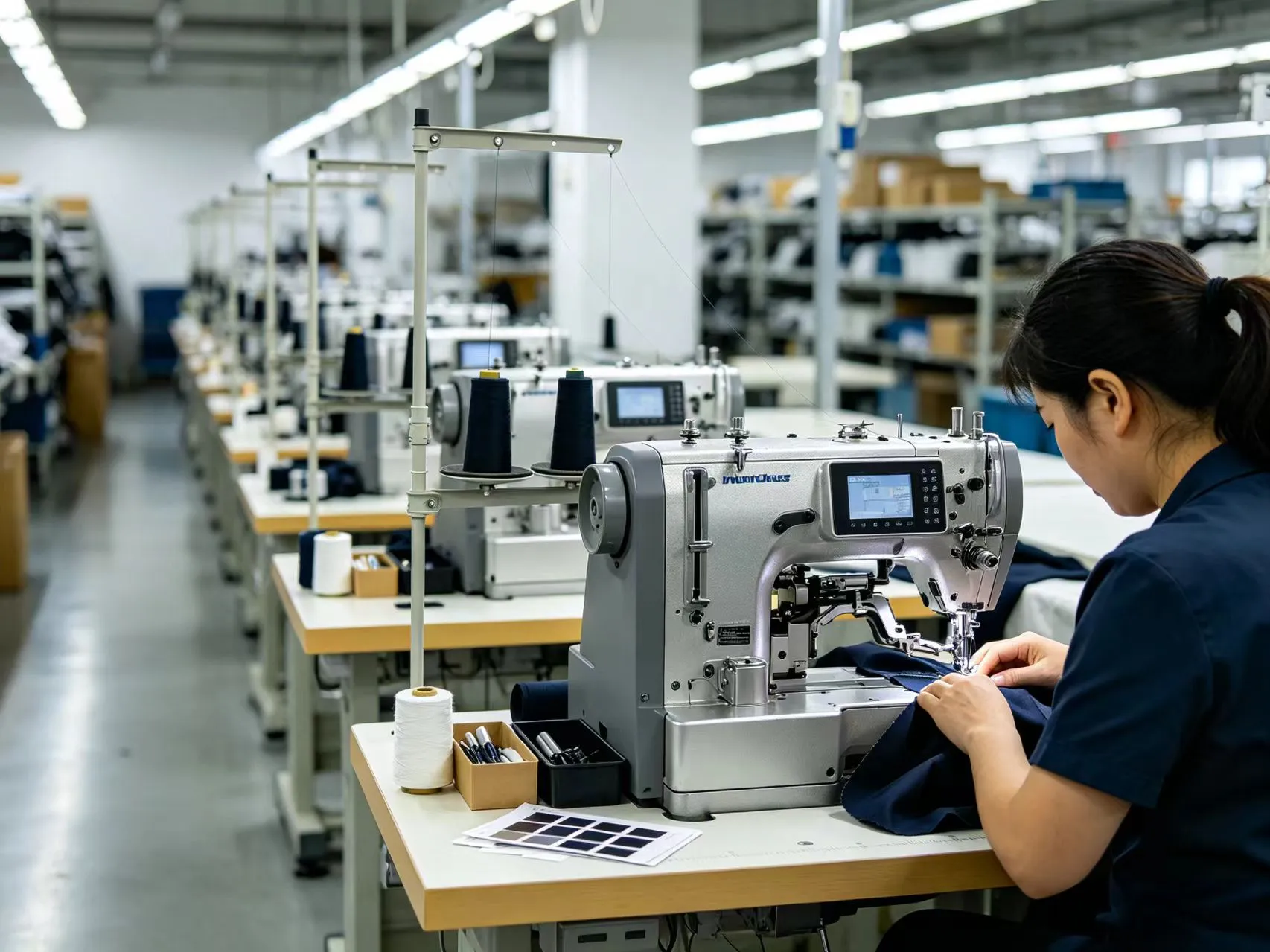
Incoming Material Inspection (Pre-Shipment Inspection for Leather Bags — Stage 1 of 7)
Pre-shipment inspection for leather bags starts when leather rolls off the truck. Most "passed" orders fall apart here, before value is added. A consistent incoming material inspection procedure is the foundation of leather bag quality control — there is no upstream fallback.
What gets checked at the door
Anything that touches the bag gets a lab-style check before it hits the floor. If a material is not on this list, it does not go in:
- Leather lots: crocking, light fastness, tear strength
- Hardware: D-rings, zippers, magnetic snaps — salt spray, every batch
- Lining: cotton or RPET, GSM and color drift
- Thread: bonded nylon or polyester, tensile strength off the cone
- Compliance: REACH limits, OEKO-TEX 100 where the buyer asks
What goes wrong when we skip a step
Black dye bleeds onto a tan lining. A D-ring rusts after one rain. A bag strap pulls out of a stitching line that "looked fine." We have a folder of photos from 2019. They stay there so the next shift remembers.
How it actually gets tested
What we do when something fails
The batch is rejected on the spot. The supplier gets a written notice — same day, not two weeks later. A CAPA gets filed and dated. If the same defect shows up twice from the same supplier, we open a new qualification cycle on a different mill and do not look back. We do not negotiate on Critical findings, not even when the buyer is breathing down our neck. Salt spray is cheap. Container rework is not. For the trade-off between third-party SGS lab tests and a material certification route, our SGS vs material certification guide compares both for incoming material decisions.
Cutting and Skiving

What gets checked at the cut table
- Cutting accuracy: every panel inside the tech pack dimension
- Piece direction: leather grain runs the same way across the panel set
- Skiving thickness: edges reduced evenly so the fold sits flat
How the operator checks it
The SOP includes a grain direction diagram per style. Skiving is measured with a caliper at each setup change. The first panel sits side-by-side with the sample before the rest goes under the knife.
What happens if something is off
Pieces go back for a re-cut, the deviation lands in the batch record, the setup sheet is updated. Cutting errors are cheap here, painful later.
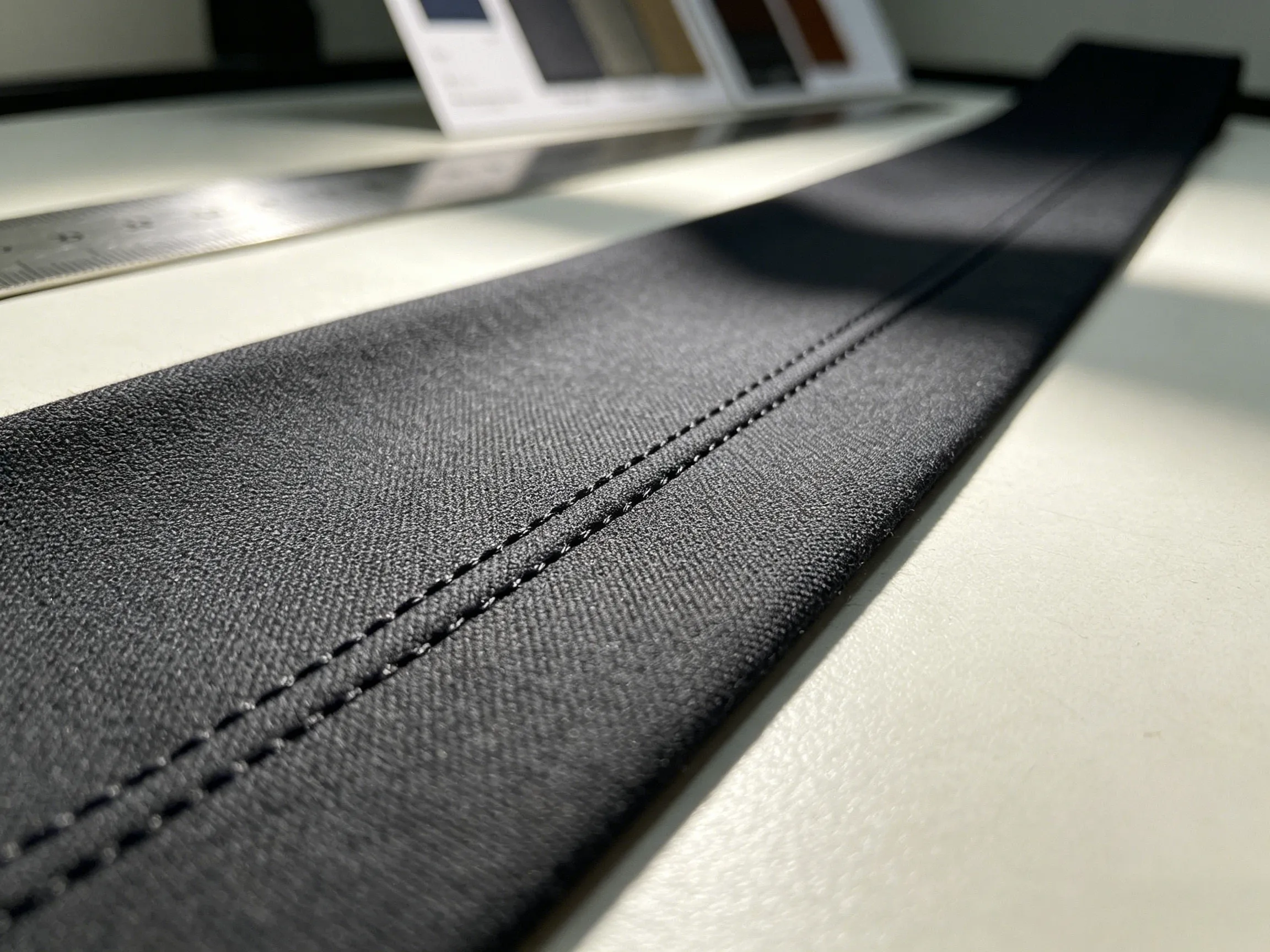
Stitching and Seam (Leather Handbag Inspection)
On the leather handbag inspection front, the eye of an experienced seamstress is non-negotiable — even after 7,000 pieces, she still walks every seam under the bench lamp.
What the line checks on every panel
- Stitches per inch: matches the spec, not "looks about right"
- Skip stitches: zero tolerance — every one gets opened and re-sewn
- Bobbin thread: does not show on the leather face
- Seam strength: tested on the pull tester, not just by feel
- Thread tension: even across the whole seam, top and bottom
What can go wrong at the sewing machine
A skip stitch becomes a tear-start point under load. Uneven tension puckers the panel and throws the next station off. A seam that breaks after three weeks is a return — the kind buyers never catch at the factory. This is also where the leather handbag quality control gap widens when a line is rushed to hit a delivery.
How we test seam strength
What happens if a seam fails
The seam is unstitched and re-run. The machine gets a tension calibration. If the failure pattern points at a bad thread batch, the whole batch is quarantined and the supplier gets a call before lunch. Half a day on the floor is cheaper than a return claim three months later.
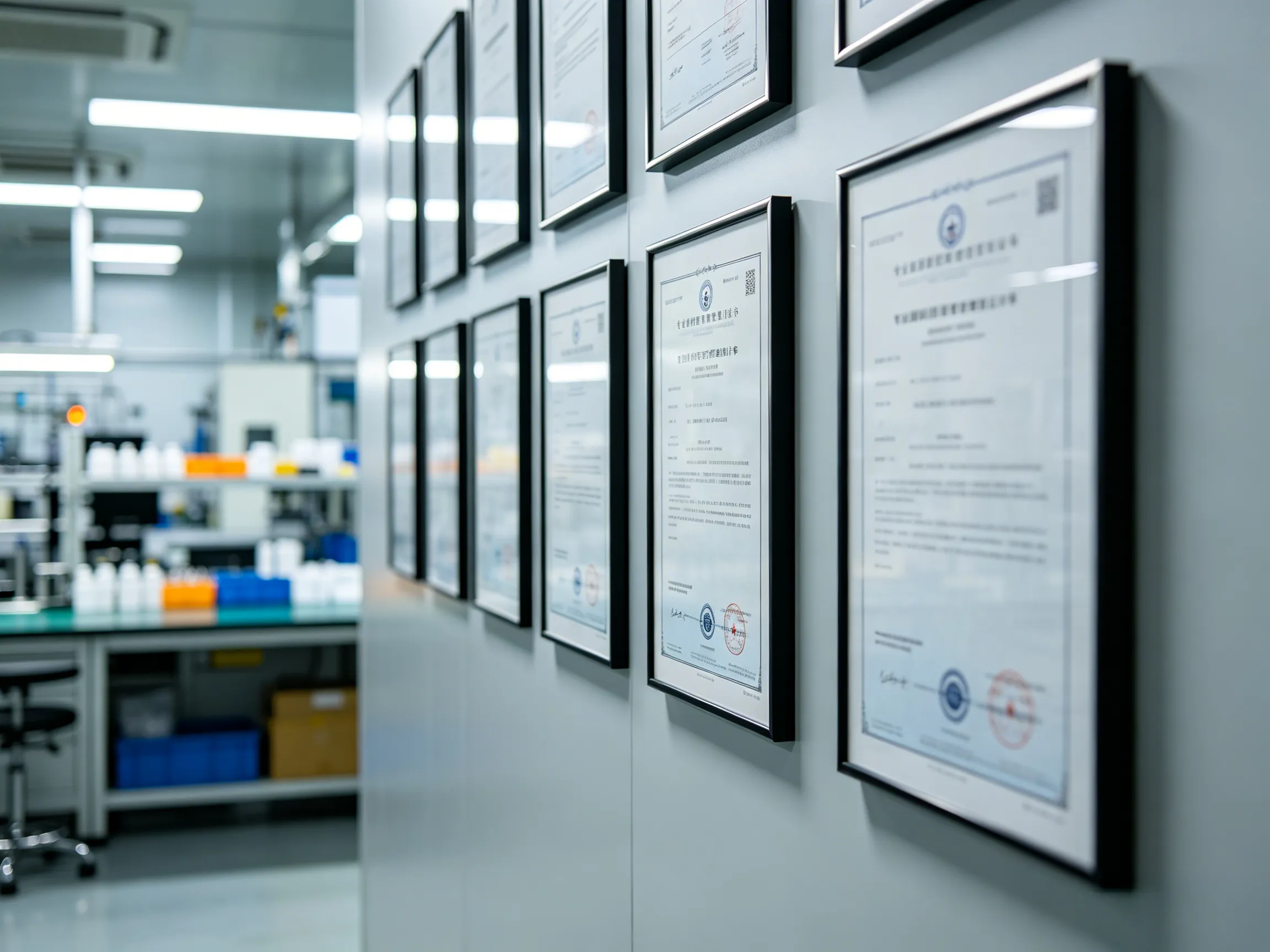
Edge Paint and Finishing

What we check on every edge
- Edge paint thickness: inside spec, not overbuilt or paper-thin
- Coat count: the right number of layers, in the right order
- Color match: against the sample under D65 light
- Adhesion: cross-cut tape test on every batch
Where edges usually fail
Edge paint is the first thing that gives up when humidity or handling changes. It peels at the corner. It cracks along the fold. The color drifts after a few months on the shelf. None of that is visible at the factory — it shows up on the customer's first rainy commute. We have a folder of close-up photos from those commutes. It is a short folder. We try to keep it short.
How we test edge adhesion
What we do when an edge fails
The edge is re-sanded, re-coated, and re-baked. The process lands in the batch file. If a batch keeps failing, the paint supplier gets a CAPA — not a friendly email, a CAPA. Edge paint is one of the first things a buyer touches when they unbox a bag, and it is also one of the most preventable defects in a controlled factory. For the upstream process that decides whether the edge survives daily use, see our leather handbag manufacturing process walkthrough.
Inline Inspection for Leather Handbags
Leather handbag quality control at Stage 5 happens while the bag is still on the bench, before the lid closes. Catch a hardware failure now, save a return ticket three months later. This is also where our leather handbag inspection cycle resets for the next panel.
What gets tested at the assembly bench
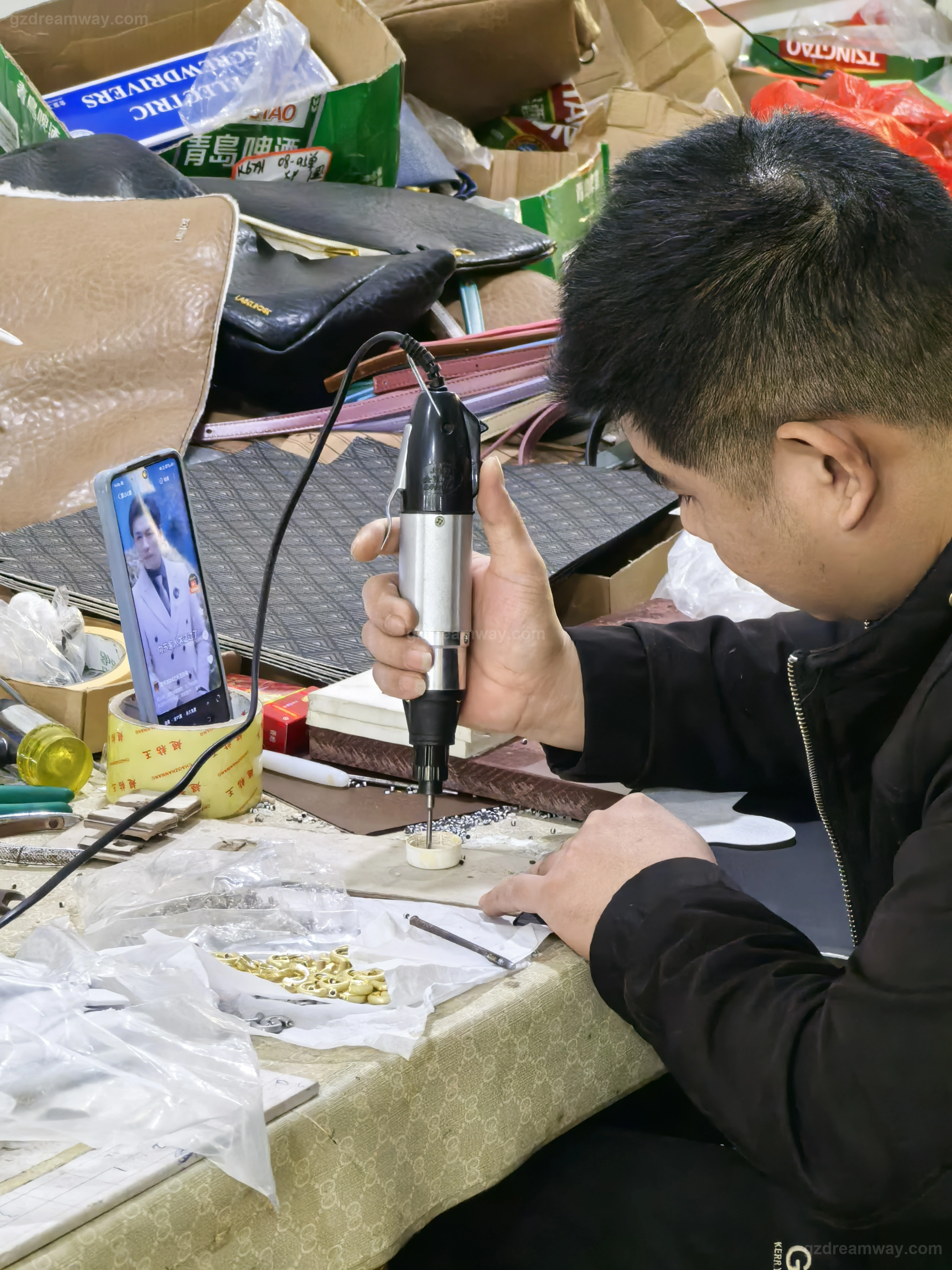
- Zipper cycles: each one runs the rated open-close count on a cycle tester
- D-ring pull: load capacity before the ring gets sewn in
- Magnetic snaps: closure strength and alignment
- Handle attachment: stress at the root, not just the surface
What can go wrong at the assembly bench
A zipper that skips at cycle 200. A D-ring that rotates under load. A handle that pulls out at the root after a normal day's carry. The bag looks fine in the box, and the customer finds the problem three months later. Inline inspection for leather handbags is the stage that catches them before the lid closes.
How we test hardware inline
What we do when hardware fails
Hardware is swapped on the spot. Load-bearing seams go back to stitching. If the same component fails on three bags in a row, the batch is held and the supplier gets a call before the shift ends. For zipper and metal tag selection, see our hardware guide. For inline vs final, see inline vs final.
Final Inspection for Leather Bags
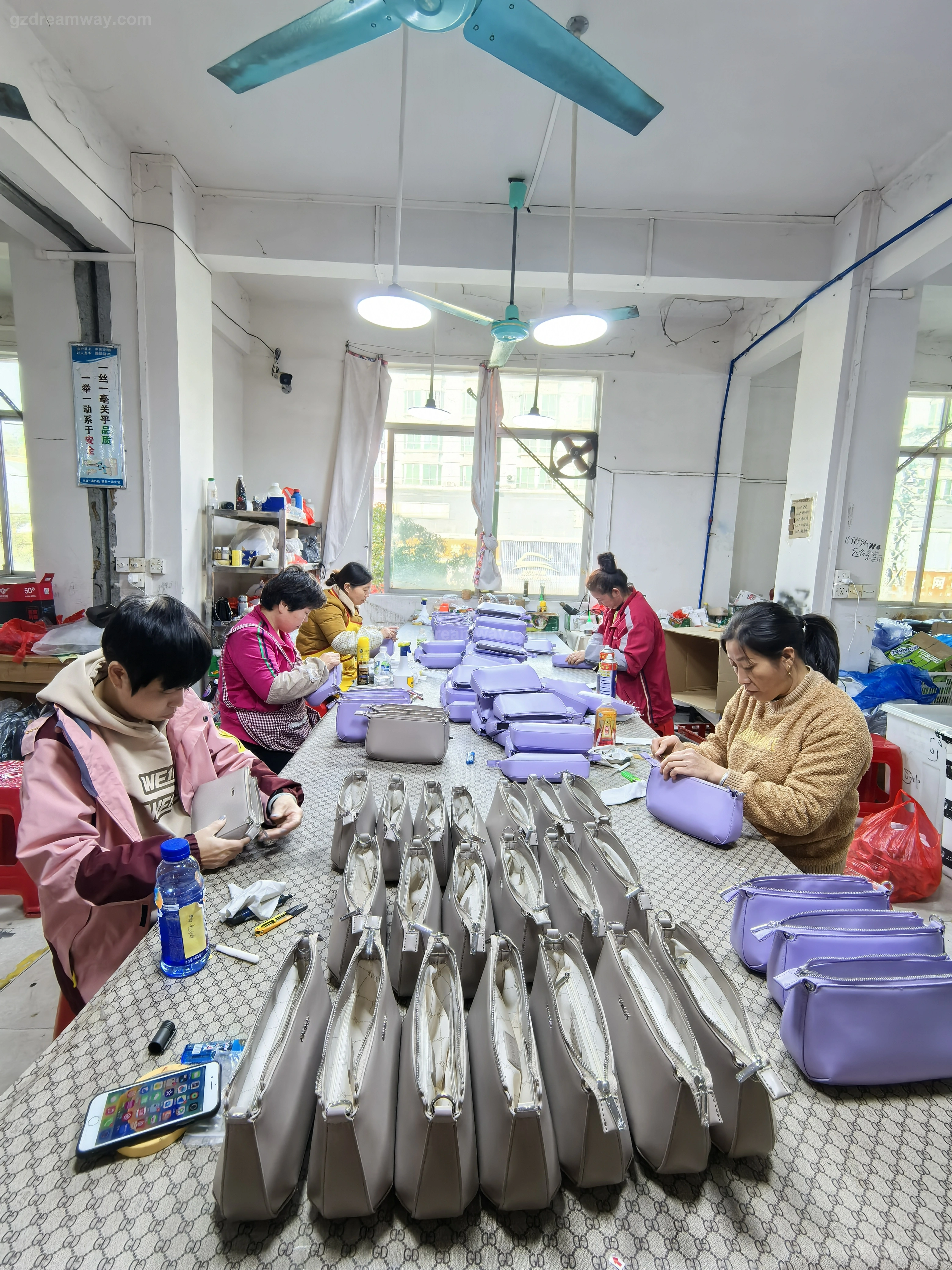
Leather bag inspection at the final stage is a two-inspector sign-off on every unit. The last chance to catch a cosmetic slip before the carton is taped shut — and where the real return-rate battle is won or lost.
What the final inspector actually checks
- Appearance: no stains, no scratches, no color drift from the sample
- Hardware: every zipper, snap, ring, and lock has to work
- Labels: brand tags, care labels, country of origin — right place, right print
- Packaging: matches the spec, right poly bag, tissue, and box
- Accessories: everything on the tech pack is in the bag
What slips through final if we get lazy
A wrong-color zipper hiding in a black run. A logo one shade off. A stitching fault that only shows up when the light hits at the right angle. These are the cosmetic slips that quietly damage a brand. Final inspection leather bags is the last line before the carton is taped shut.
How the inspection actually runs
The finished product SOP runs every unit through a five-point check. Two QC staff work the line independently. When they disagree on a unit, it goes to the senior supervisor for a final call. We do not average the opinions — we escalate.
What happens if a defect slips through final
Repair or replace. If a replacement is not possible, we go back to the buyer with a concession offer and a CAPA. Critical defects never ship, even if the buyer is willing to take a discount on the lot.
Pre-Shipment Inspection for Leather Bags (AQL 2.5)
Pre-shipment inspection for leather bags is the seventh stage. Everything before it was preparation. This is the last statistical gate before the container is sealed.
What the PSI covers
AQL (Acceptable Quality Limit) is a statistical sampling plan. It lets us make a confident call on a full lot without opening every carton. We use ISO 2859-1 as the reference and pick G-II normal for most orders, G-I tightened when buyer risk is higher.
- Sample plan: G-II normal, tightened to G-I for premium buyers
- Defect classification: Critical, Major, Minor
- Measurement data: logged against spec, used for trend analysis
Defect classification
| Level | Definition | Acceptance |
|---|---|---|
| Critical | Functional or safety issue that stops the bag from being used | 0% — full rejection |
| Major | Visible defect that affects how the bag looks or works | AQL 2.5 |
| Minor | Cosmetic issue, easy to miss at arm's length | AQL 4.0 |
What happens if the buyer re-rejects
Re-inspection under G-I, rework or concession, and a CAPA on a Critical re-rejection. Our full PSI checklist covers the SOP. See also AQL vs 100% and AQL 1.0 vs 2.5 vs 4.0.
A 7-stage chain is not overkill — it is the minimum we ship against. For brands still deciding between sourcing models, our OEM vs ODM vs private label guide explains how QC depth shifts between the three.
AQL 2.5 Inspection for Handbags — In Plain English
The mix-up we hear every week
❌ Wrong: "AQL 2.5 means we can have up to 2.5% defects in the order."
✓ Right: "AQL 2.5 is the upper bound of acceptable defects in the sample, under the chosen sampling plan."
What the standard actually says
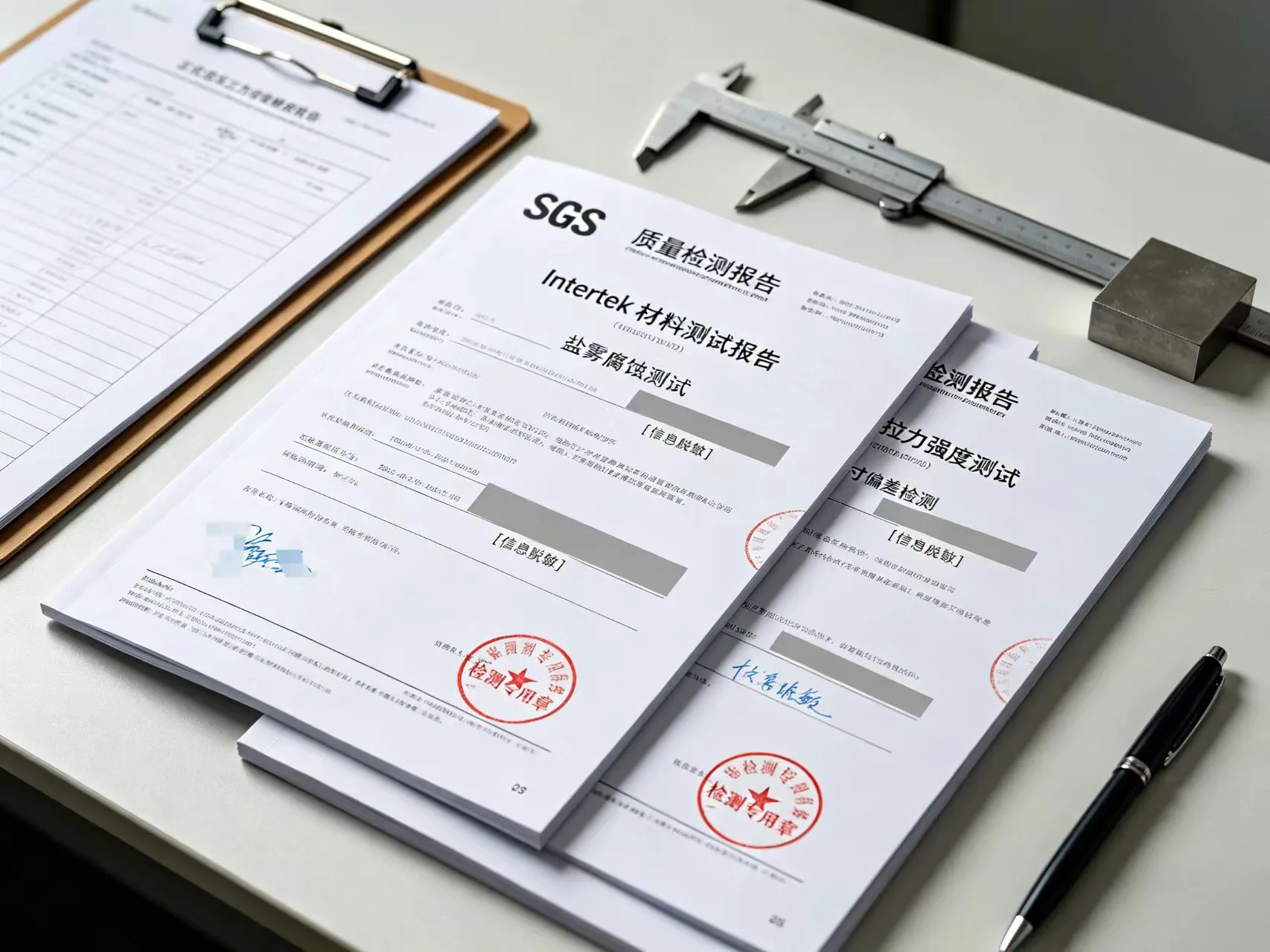
Pre-shipment inspection for leather bags at AQL 2.5 is a sampling limit, not a defect allowance. We follow ISO 2859-1 globally or ANSI/ASQ Z1.4 in North America. The 2.5 is the upper-percent-defective boundary under the chosen plan — not a permission slip.
Critical / Major / Minor classification
Our default is AQL 2.5 for Major and 4.0 for Minor. Buyers can ask for tighter (AQL 1.0 for premium) or looser (AQL 4.0 for promotional). Critical defects are not part of the AQL conversation — they are rejected on first sight, and a CAPA is opened before the unit goes back into the line.
How to read an AQL table
Look at your lot size in the left column — the row tells you the sample size. The columns to the right show Ac / Re. Defects at or below Ac: the lot passes. Above Ac: rework or re-inspection under a tighter plan. That is the whole mechanic.
For a side-by-side look at the three most common levels, see our AQL 1.0 vs AQL 2.5 vs AQL 4.0 guide.
What buyers tell us after their first lot
Some buyers come back from their first PSI and say "I thought it would be more complicated." It is not — just unfamiliar. After two or three lots, the language becomes normal. By the fourth order, you stop reading the AQL table.
"We were skeptical about a 7-stage chain adding cost and friction. It actually did neither. Returns dropped, our CSAT went up, and the CAPA folder is now the first thing our QC lead reads on Monday."
8 Documents Buyers Should Demand Before Signing a QC Report
Before you sign off on a shipment, walk your factory through these eight points. Any "no" is a reason to slow down. The list is also a leather bag qc checklist for your sourcing team:
- 1 FAI: First Article Inspection data for this specific order. For the upstream step that decides whether your sample ever matches the bulk, see our leather bag sample development process.
- 2 Inline photo log: process shots at each critical control point, time-stamped.
- 3 Inline QC report: mid-production check, signed by the line lead.
- 4 100% Final Inspection: every unit, not just a sample. Sign-off form on file.
- 5 AQL plan: ISO 2859-1, with the level and the Ac number documented.
- 6 Defect log: count and class (Critical / Major / Minor), with photos.
- 7 CAPA on Critical: written root cause and corrective action.
- 8 PSK sign-off: pre-shipment sample approved against the original. Our PSK sample approval checklist walks through the steps.
For a deeper read on what each line of a factory report means, see our guide on how to read a QC report.
The People Behind the 7 Stages (E-E-A-T)
Kevin
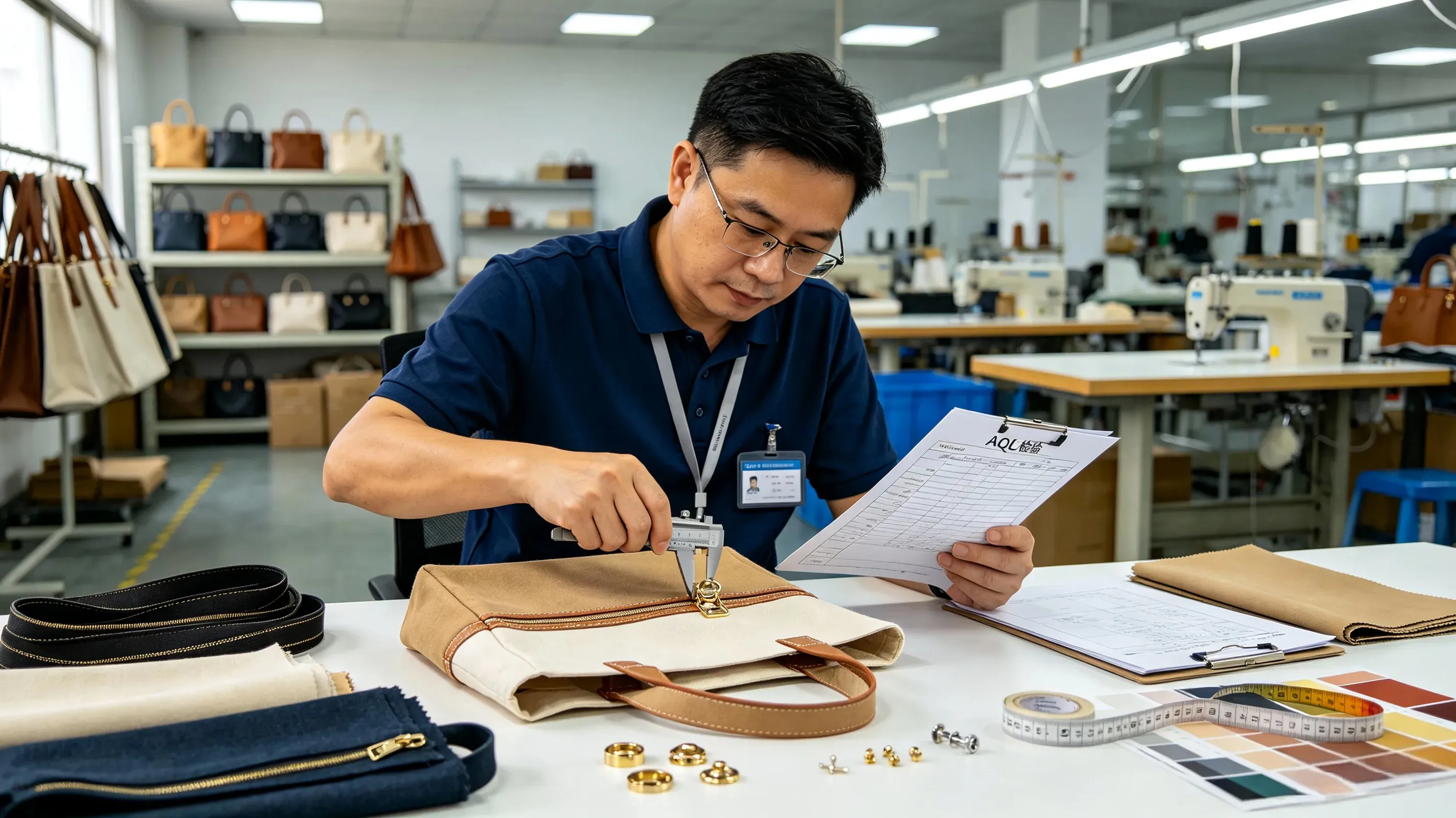
Fifteen years on the pattern table — leather, canvas, nylon, technical fabrics. Kevin's patterns are why our cutting stage holds to spec. He is the first person buyers meet on a new style. Process notes on our Dreamway LinkedIn.

Emily
Twelve years in OEM bag manufacturing, running 15 to 25 active projects at the same time. Emily is the person who keeps the timeline honest, the buyer updated, and the line fed. Most of our buyers have her number first.
Helen
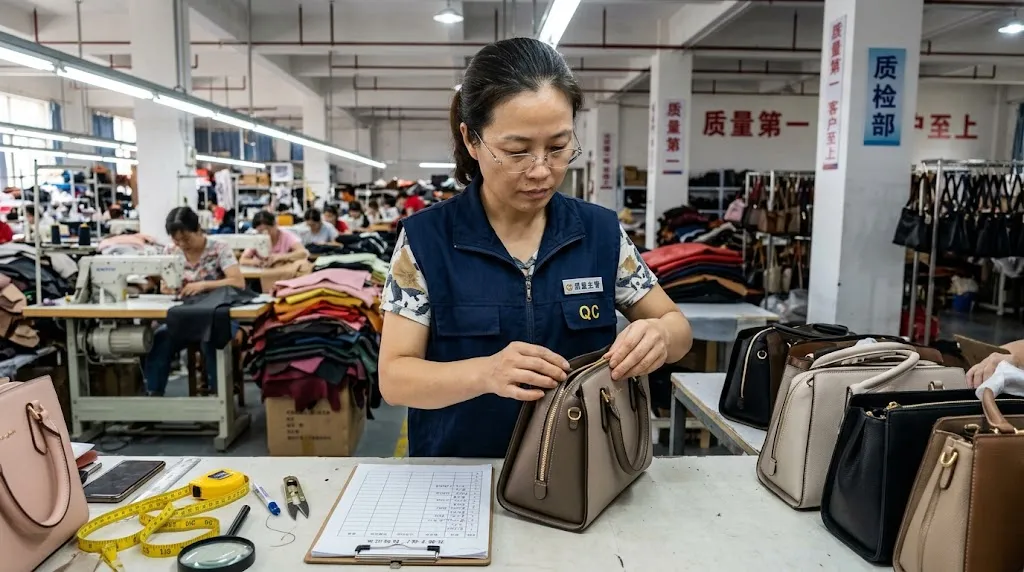
Thirteen years on the QC side, mostly leather handbags. Helen's team writes the inspection SOPs, runs the AQL sampling, and signs off on every PSI report. If a defect reaches a buyer, it is news to her first.
When the Chain Fails: A Hardware Salt Spray Case Study
A leather bag quality control case worth telling — every part of the 7-stage chain had to fire in the same afternoon. Here is what that afternoon looked like on our floor.
What happened
A hardware supplier changed their electroplating formula without telling us. The first signal was faint surface rust at the 20-hour mark on the salt spray test. The bag looked fine. The hardware looked fine. The chamber told the truth a few weeks before the customer would have.
The chain reaction
The line was held within the hour. The supplier was brought in, the formula change was traced, and a replacement lot was sourced. From that point, every batch runs through 100% incoming salt spray, not a random pull. The supplier now has to flag any coating change in writing.
The corrective action
The CAPA sits on the QC supervisor's desk. It lists the failed lot, the root cause, the new rule, and a 30-day review date. It is a living document, not a one-time form. The next round of the same style is graded against it before the bag ships.
What buyers can learn
Push for a written CAPA on every Critical finding. A 7-stage chain is only as strong as its paper trail.
"Salt spray caught a hardware issue on our 2022 autumn line before it ever hit a customer. We saved a full container, and possibly the season. That one check earns its keep."
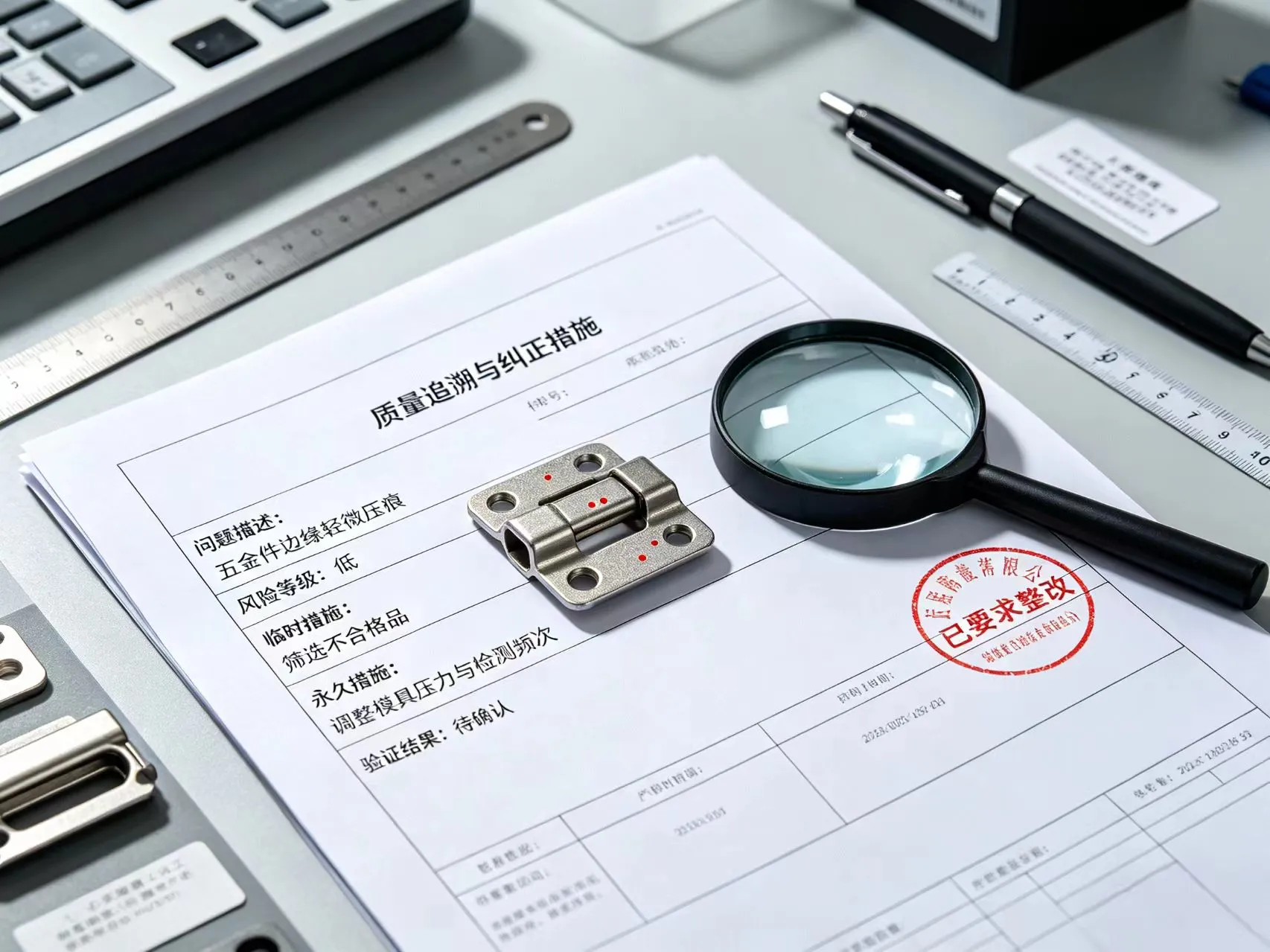
How This Compares to Standard Leather Bag Inspection
A chain of seven stages upgrades leather handbag quality control beyond a single leather bag inspection — and a working leather bag quality control checklist is what binds the seven stages together.
vs single-point inspection
Most small workshops and many tier-2 factories still run a single end-of-line check. The defect escapes, the bag ships, the customer finds the problem three months later. A 7-stage chain pulls the same defect out at incoming — cheaper, faster, usually invisible to the buyer's QC team. The math changes once you get past 500 units.
vs tier-2 factory QC
Tier-2 factories often run a 2- or 3-stage chain: incoming, inline, final. That works for simple styles but misses salt spray on hardware, AQL sampling, and FAI paperwork. A 7-stage chain is what you ask for on a premium line, an Amazon BSR SKU, or a brand with a public return-rate target.
vs third-party-only
Some brands outsource leather bag inspection to SGS or Bureau Veritas at the end. That gives you a single check, on a single day, by an inspector who has never seen the line. It catches some defects, misses the upstream ones, because the inspector was not there when the leather arrived. A factory-side chain plus a third-party PSI is what closes the loop.
What this means for OEM brands
Putting a 7-stage chain in front of a new factory means a 30-day learning loop. The QM, line lead, and senior QC all walk the SOP together before the first PO. Once it is running, the chain runs itself — and that is when returns drop to single digits.
| Inspection model | Stages | Upstream defects caught | Field return rate | Best fit |
|---|---|---|---|---|
| Single-point final | 1 | ~10% | 12–18% | Promotional, low-cost SKUs |
| Tier-2 (3-stage) | 3 | ~40% | 6–9% | Mid-market handbags |
| Third-party only | 1 | ~20% | 8–12% | One-off audit orders |
| 7-stage chain (us) | 7 | ~85% | 1.5–3% | Premium OEM, BSR, luxury |
These numbers are pulled from our own line over the last 24 months — not from a marketing deck. They are also why the leather bag quality control conversation in our onboarding calls always ends with the same question: how much return risk are you willing to carry?
Run Your Next Order Through the Same 7 Stages
Bring this leather bag quality control checklist to your next supplier meeting. Small team in Huadu, Guangzhou. MOQ 200 for leather bags, 50 for silk. We have shipped to 50+ countries since 2008. The chain above is what every order runs through. See it live, come visit; otherwise, hand this checklist to your factory.
Browse related guides
See the OEM, ODM, and private label paths in our Custom Luxury Program.
Open GuidePhone: 86-020-87682749 · Email: Victoria@gzdreamway.com · Info: info@gzdreamway.com
External standards referenced in this guide
- ISO 2859-1 — Sampling by attributes
- ANSI/ASQ Z1.4 — North American equivalent
- OEKO-TEX Standard 100 — Harmful substance certification
- REACH — EU chemical regulation