
This article breaks down the real production cost of custom handbags, focusing on labor vs. material cost percentages. We reveal industry-standard cost ratios, key expense components, and how factors like MOQ (200 units) impact pricing. Whether you’re a startup brand or established retailer, this guide helps you calculate accurate budgets, avoid overpaying factories, and partner with reliable handbag manufacturers for cost-effective, high-quality production.
Unlocking the Truth: Handbag Production Costs – Labor vs. Material Ratios
For brand owners, retailers, and entrepreneurs entering the custom handbag industry, the #1 question is always: How much does it actually cost to make a handbag? Most factories only share a final unit price, leaving you in the dark about what percentage goes to materials, labor, and overheads. This transparency gap leads to budget miscalculations, low-profit margins, and unexpected production costs.
At GzDreamway, a leading custom handbag and tote bag manufacturer in China with a MOQ of 200 units, we’ve produced over 10 million custom bags for global brands. We’re pulling back the curtain on the industry’s most guarded secret: the exact labor and material cost percentages that define every handbag’s production price. This data is based on 15+ years of B2B manufacturing, covering canvas totes, PU leather handbags, diaper bags, and luxury custom bags.
.webp)
This high-tech visual represents the core cost structure of handbag manufacturing: materials dominate the largest share, followed by skilled labor, with overhead and logistics making up the remainder. Understanding this ratio is the first step to negotiating fair prices with your factory partner.
Material Costs: The Largest Portion of Handbag Production
Materials are the single biggest expense in handbag manufacturing, accounting for 45% to 65% of the total unit cost. This category includes all physical components that form your handbag, and every choice you make directly impacts this percentage.
Key material components include:
- Main fabric: Canvas, PU leather, polyester, RPET recycled material, or genuine leather
- Hardware: Zippers, metal buckles, buttons, and custom logo tags
- Linings: Waterproof fabric, cotton, or mesh
- Accessories: Thread, glue, edge paint, and insulation padding
- Packaging: Poly bags, hang tags, and custom boxes
For example, a premium PU leather handbag will have a 60% material cost ratio, while a basic canvas tote sits at 45% – the quality of raw materials directly shifts this percentage. If you’re comparing materials, our guide to Canvas vs. Polyester vs. PU breaks down cost and durability differences for every material type.
Labor Costs: Skilled Craftsmanship vs. Mass Production
Labor costs make up 25% to 40% of total handbag production costs, a critical figure that separates low-quality fast fashion from premium, durable bags. Unlike automated industries, handbag production relies heavily on skilled workers for cutting, sewing, logo embroidery, quality control, and assembly.
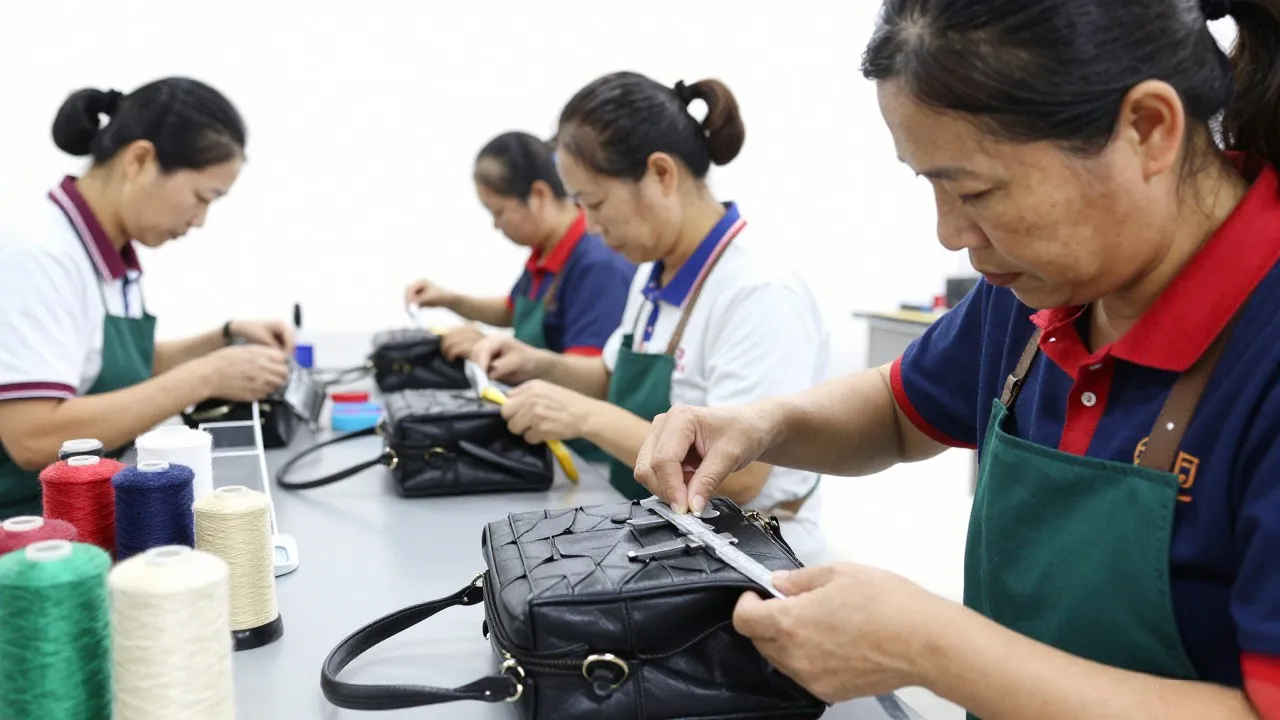
Labor expenses cover:
- Skilled seamstresses for precision sewing and logo stitching
- QC inspectors to eliminate defects (critical for brand reputation)
- Cutting technicians for accurate fabric shaping
- Packing and warehouse staff for order fulfillment
Contrary to popular belief, higher labor costs do not mean overpaying – they mean investing in craftsmanship. Cheap labor often results in loose stitching, uneven prints, and faulty hardware, costing you more in returns and damaged brand trust. Our Tote Bag Quality Control Guide explains how skilled labor directly impacts final product quality.
Overhead & Additional Costs
The remaining 5% to 15% of total costs covers factory overheads: rent, utilities, equipment maintenance, design support, and compliance certifications (OEKO-TEX, GRS, CPSIA). These costs ensure your factory operates legally, sustainably, and with professional production standards – non-negotiable for global retail brands.
Handbag Production Cost Percentage Breakdown (Industry Standard)
| Cost Category | Percentage Range | Key Components | Impact on Pricing |
|---|---|---|---|
| Raw Materials | 45% – 65% | Fabric, Hardware, Linings, Accessories | Largest variable cost; material quality drives this ratio |
| Skilled Labor | 25% – 40% | Sewing, QC, Cutting, Assembly | Directly linked to craftsmanship and product durability |
| Factory Overhead | 5% – 10% | Rent, Utilities, Equipment | Fixed cost; minimal impact on unit pricing |
| Logistics & Waste | 3% – 5% | Shipping, Material Waste, Packaging | Reduced with higher order quantities (MOQ 200+) |
| Total Production Cost | 100% | All Expenses Combined | Final unit price for custom handbag orders |
How MOQ 200 Impacts Labor & Material Cost Percentages
One of the most impactful factors on cost ratios is your Minimum Order Quantity (MOQ). At GzDreamway, we offer a low MOQ of 200 units – the perfect balance for startup brands and small businesses. Here’s how this MOQ optimizes your costs:
1. Material Bulk Discounts: 200 units qualify you for wholesale material pricing, lowering the material cost percentage by 5-8% compared to sample orders.
2. Labor Efficiency: Factory workers streamline production for 200 units, reducing labor time per unit and cutting labor costs by 3-5%.
3. Lower Overhead Allocation: Fixed overhead costs are spread across 200 units, reducing the per-unit overhead percentage.
For brands scaling from small batches to mass production, our article Shifting from Small MOQ to Mass Production provides a step-by-step cost optimization strategy.
.webp)
This exploded view shows every material component of a custom handbag – each piece contributes to the 45-65% material cost ratio we outlined earlier. Precision in material selection directly reduces waste and lowers your total production cost.
How to Calculate Your Custom Handbag Budget (Pro Tips)
Using the labor vs. material ratios above, you can create a 100% accurate budget for your custom handbag order. For automated calculations, use our Tote Bag Cost Calculator – the ultimate tool for estimating unit costs based on material, labor, and MOQ.
To avoid hidden fees, partner with a transparent manufacturer like GzDreamway that provides a full cost breakdown before production. Our Handbag Manufacturing Cost Structure Breakdown dives deeper into hidden expenses and how to avoid them.
Choosing the right factory is just as important as understanding costs. Our guide How to Choose the Best Tote Bag Factory helps you vet suppliers for transparency, quality, and fair pricing.
GzDreamway Official Homepage
Leading custom handbag & tote bag manufacturer with MOQ 200
Contact Our Factory
Get a free cost breakdown for your custom handbag project
MOQ 200 Guide
Learn how low MOQ reduces your production costs & risk
Frequently Asked Questions (FAQ)
1. What is the average material vs labor cost percentage for a custom handbag?
Materials account for 45-65% of total production costs, while skilled labor makes up 25-40%. Overhead and logistics cover the remaining 5-15%.
2. What is your MOQ for custom handbag production?
GzDreamway has a low MOQ of 200 units for all custom handbag and tote bag orders, ideal for startups and small brands.
3. How do material choices affect total handbag costs?
Premium materials (PU leather, recycled fabric) increase the material cost percentage to 60-65%, while basic canvas reduces it to 45-50%.
4. Does higher labor cost mean better quality handbags?
Yes! Higher labor costs fund skilled seamstresses and strict quality control, resulting in durable stitching, perfect prints, and defect-free bags.
5. How can I reduce my custom handbag production costs?
Opt for our MOQ 200 to get bulk material discounts, choose cost-effective materials, and work with a transparent factory to avoid hidden fees.
Final Thoughts: Partner with a Transparent Handbag Manufacturer
Understanding labor vs. material cost percentages is the key to profitable custom handbag production. No longer will you accept vague factory quotes – you’ll have the data to negotiate fair prices, optimize your budget, and create high-quality bags that resonate with your customers.
At GzDreamway, we prioritize transparency for every client. Our MOQ 200, full cost breakdowns, and expert design support make us the top choice for global brands launching custom handbags, tote bags, and diaper bags. Whether you need eco-friendly RPET bags, luxury PU leather handbags, or promotional canvas totes, we deliver cost-effective, premium production tailored to your brand.
Ready to get started? Contact our team today for a free, no-obligation cost estimate and take the first step towards successful handbag manufacturing.
Premium bag & silk manufacturing — under one factory roof.
Tucked inside Shiling Town — Guangzhou’s centuries-old leather district — Dreamway is a focused manufacturing partner for brands that refuse to compromise. We build rugged, retail-ready tote bags, backpacks, handbags with a 200-piece MOQ, and craft 100% Mulberry silk pillowcases, scrunchies & sleep accessories starting from just 50 pieces. Our small team of 30+ artisans is senior, hands-on, and accountable — the same people who quote your sample will personally inspect your shipment.
Every order is verified against our published manufacturing quality standards — AQL 2.5 inspection, hardware pull-tests, seam-strength audits, and silk-fibre authenticity checks. From concept tech-pack to mass production, we run the entire supply chain in-house, so timelines stay honest and revisions stay painless.
Buying Guides & Manufacturing Insights
Sourcing smarter starts with knowing what to compare. These long-form guides break down the decisions our clients wrestle with most — from third-party inspections like the SGS vs Intertek vs Bureau Veritas showdown, to ranking China’s top 10 tote bag manufacturers, to the head-to-head of canvas vs polyester vs PU for bag bodies.
Designing your logo? Our custom tote bag logo size guide shows real placement and stitch-density examples. Curious how a handbag actually comes together? Walk through the leather handbag manufacturing process step by step, and pair it with the canvas tote durability factors that decide whether a bag survives five years of daily use.
For material decisions beyond canvas, compare PU vs polyester for bags and explore our roundup of the world’s top canvas bag manufacturers. If backpacks are your lane, our backpack manufacturing process and backpack lead-time guide give you realistic production windows. Choosing between social-compliance audits? Read BSCI vs SEDEX vs WRAP. For smaller leather goods, dive into the leather wallet manufacturer playbook; for sustainability claims, the recycled PU leather explainer and our backpack QC checklist separate marketing from reality. Finally, stay ahead of EU regulation with our PPWR FAQ for bag manufacturers.
Explore by Topic
Browse our deep-dive knowledge hubs — every cluster is curated by category and updated with new field reports.
By Category
Materials & Compliance
Real Client Cases
Numbers tell part of the story. These production cases show how Dreamway’s small team delivers at scale.
Featured Product Lines
A snapshot of what we manufacture most often — all OEM/ODM-ready with custom hardware, lining, and packaging.
Who We Help
From indie founders to global enterprise — Dreamway is built for brands that need a factory, not a freelancer.
Brand Builders
Beauty & Fashion
Lifestyle & Retail

Skip the inbox. Chat with Victoria — right now.
Point your camera at the QR and you’re connected to a real human in Guangzhou. Send a photo of your reference, get a quote within minutes, and lock in your 200-piece MOQ slot before this month’s capacity fills.
Specialized factories. Unified standards.
Leather & Bag Capital
Our bags come from Guangzhou’s Shiling leather district — home to 30+ senior artisans under one roof, working in 8,000 m² of integrated cutting, sewing, hardware-assembly, and QC space.
Mulberry Silk Heritage
Our 22mm Mulberry silk pillowcases and sleep sets come from vetted partner mills in Suzhou and Hangzhou — at the heart of China’s 5,000-year sericulture heritage, today running OEKO-TEX Standard 100 certified production lines.
Get your sample in 7 working days —
hand-built by Guangzhou’s 30+ artisans.
Send a sketch, a screenshot, or a competitor’s bag you want to beat. We’ll hand-build a custom sample and ship it to your door — produced by the same craftspeople who will run your mass-production order.
business days · in your timezone
on request · signed in 1 day
if first one misses the brief
Discover the World of Exquisite Clutch Bags
From elegant evening clutches to sophisticated everyday designs, our curated collection showcases the finest craftsmanship in leather accessories. Explore our comprehensive range of women’s clutch purses crafted by skilled artisans with decades of experience.
Featured Clutch Collections
Ready to find your perfect clutch bag? Our dedicated team is here to help you source premium accessories that elevate your brand.
Explore Full Clutch CollectionManufacturer Knowledge Hub
Twenty-two practical guides from our Guangzhou factory — covering everything from clutch sourcing, MOQ strategy, and quality control to tariffs, tech packs, and compliance. Each card opens a dedicated resource built from real production data.
Manufacturing & Products
Clutch Purses Manufacturer
Browse the full OEM clutch catalog — from evening minaudières to daytime wristlets — all built to your brand’s specs in our Guangzhou workshop.
Browse the full catalog Private LabelPrivate Label Leather Handbags
Launch a private-label leather line with low MOQs, custom hardware finishes, and dedicated pattern engineers who own your project end to end.
Plan your private label MaterialsGenuine Leather from China
Source full-grain and top-grain leather handbags direct from a Guangzhou maker with long-standing tannery partnerships and traceable supply.
Source full-grain leather Case StudyCustom Leather Clutch — A Success Story
Read how a European fashion brand grew from a cautious 30-piece trial into multi-thousand-piece annual reorders of bespoke clutch bags.
Read the case study Rush OrderRush-Order Logo Tote Bags
Need totes in two weeks? Our express lane ships custom-logo totes with full inline QC and export packing — without skipping any approval step.
Reserve a rush slot LogisticsImport Tote Bags: Shipping, Duty, Lead Time
A complete playbook on import logistics — port-to-port transit, customs duty brackets, and the realistic total lead time from PO to your warehouse.
Map your import routeQuality & Compliance
Tote Bag Quality-Control Checklist
Our 47-point QC checklist covers stitch density, colorfastness, hardware pull-strength, and packing — applied to every shipment, every order.
Download the QC checklist SamplingHandbag Sample-Approval Checklist
Use the same nine-step sample approval workflow our merchandisers run before any bulk production begins — and avoid costly reworks downstream.
Run the sample workflow ComplianceHandbag Compliance: REACH & Prop 65
A plain-English map of REACH SVHC, Prop 65, and CPSIA — learn which handbag materials trigger which compliance rules for US and EU markets.
Decode compliance rulesProcess & Capacity
How Low-MOQ Manufacturing Works
How low-MOQ production stays profitable — pattern sharing, modular components, and a dedicated small-batch line that keeps unit costs sensible.
Tour the MOQ workflow FactoryAbout Our Tote Bag Factory
Meet the 15-year tote bag factory behind your brand — 450 artisans, 18 production lines, and a weekly capacity of 80,000 units across cotton and canvas.
Meet our 450 artisans PaymentsHandbag Factory Payment Terms
T/T 30/70 vs L/C at sight vs D/P — the actual payment terms our clients use for first orders and repeat orders, with pros and cons explained.
Compare payment terms CostingHandbag Cost-Structure Breakdown
See exactly what drives handbag cost — materials 38%, labor 24%, hardware 11%, overhead 18%, margin 9% — with the levers you can actually pull.
Open the cost breakdown PricingEight Price Factors in Handbag Quotes
Eight pricing variables that shift a $9.50 handbag quote to $14.20 — leather grade, lining fabric, zip-pull alloy, edge paint, and four more.
Map the price leversDesign & Technical
Handbag Design Trends 2026
Color, hardware, silhouette, and material forecasts for SS26 handbag collections — curated from Milano and Paris runway shows plus buyer feedback.
Forecast SS26 designs TariffHandbag HS Code Complete Guide
HS codes 4202.21, 4202.22, 4202.31, 4202.32 — find the right tariff line to avoid customs delays and misclassification on every handbag shipment.
Decode HS codes Tech PackHandbag Tech Pack Template
Free handbag tech pack template with bill-of-materials, stitch specs, hardware callouts, and tolerance tables — drop in your numbers and ship.
Get the tech pack template EngineeringTech-Pack Cost-Down Engineering
Five engineering moves that quietly cut $1.80 per bag — reinforcement layouts, seam reductions, and material substitution that buyers never see.
Cut $1.80 per bagSourcing Strategy & Contact
Tariff Engineering with HTS Code Hacks
Reclassify components to shift handbag tariffs from 10% to 3.3% — legally, with proper HTS documentation that survives a CBP audit.
Reclassify duty lines RiskThe True Cost of Cheap Handbag Factories
Five risks of buying from $4.50/bag factories — defect rates, compliance gaps, IP exposure, and what they really cost your brand over three seasons.
Audit factory risks ContactStart Your Project with Our Team
Send your tech pack and get a working sample in seven days — three ways to reach our merchandising team and the fastest path from sketch to shipment.
Start a 7-day sampleEditorial Resources for Leather Bag Manufacturing & Sourcing
For buyers, designers, and category managers evaluating private label leather handbag programs, our editorial team in Guangzhou has compiled reference material covering material science, REACH and Prop 65 documentation, production workflow, factory audit criteria, and unit cost modeling. Begin with the leather bag manufacturing topic cluster category page or browse a section below.
Topic Cluster
1 guideVisit our leather bag manufacturing topic cluster category page for an editorial index of private label program overviews, supplier comparison studies, material sourcing guides, and production workflow references curated for global leather bag buyers.
Materials & Sustainability
5 resourcesUnderstand why water based PU leather has become a preferred coating for sustainable handbag programs, with notes on its solvent-free application, softer tactile feel, lower VOC emissions, and compatibility with premium bag collections.
Review our side-by-side comparison of water based PU versus recycled PU characteristics covering tensile strength, aging performance, surface feel, environmental footprint, and price stability for sustainable bag sourcing.
Discover the future of vegan leather alternatives including pineapple leaf fiber, cactus pulp, mushroom mycelium, and apple skin composite materials suitable for plant based bag collections.
Read our safety analysis on whether recycled PU leather is toxic, covering chemical leaching risks, heavy metal content thresholds, certified eco label verification, and buyer checklist for compliance.
Partner with our sustainable leather handbag manufacturer offering eco certified leather sourcing, vegetable tanning options, recycled metal components, and traceability reporting for environmentally conscious collections.
Compliance & Trade
3 resourcesNavigate our REACH and California Prop 65 compliance roadmap for handbags, covering restricted substance lists, accredited laboratory testing protocols, and certification documentation required across US and EU markets.
Reference our complete HS code guide for handbags totes and pouches with tariff classifications, duty rate summaries, and customs documentation notes for major destination markets worldwide.
Apply our factory audit checklist for remote supplier vetting covering production capacity verification, working condition reviews, export documentation sampling, and quality management system confirmation steps.
Production & Craftsmanship
5 resourcesFollow our how to create a handbag tech pack template specifications covering dimension callouts, material references, hardware notes, tolerance definitions, and QC checkpoints that bridge designers with factory production teams.
Study our deep dive into bag hardware selection covering zipper pull strength ratings, metal tag plating thickness standards, slider fatigue testing procedures, and plating adhesion validation for premium bag construction.
Walk through our complete leather handbag manufacturing process covering material preparation, panel cutting, machine stitching, edge painting, sub-assembly, final assembly, and inline quality inspection stages at a modern factory.
Follow our leather bag sample development process timeline covering pattern drafting, hardware confirmation, material swatches, sample revision rounds, and sign-off milestones for new handbag designs.
Explore our Guangzhou leather bag manufacturing cluster overview covering regional supplier networks, skilled artisan availability, raw material sourcing hubs, and consolidated export logistics advantages for global importers.
Quality & Pricing
4 resourcesApply our leather bag quality control checklist covering stitching tolerance ranges, hardware fatigue testing, color fastness verification, lining inspection, and final packaging audits before any shipment leaves the factory floor.
Identify the seven factors that affect custom handbag unit costs including material grade, hardware selection, lining fabric, surface finish, order quantity, packaging complexity, and one-time tooling investment for accurate budget planning.
Review our handbag factory payment terms guide covering T/T and L/C settlement schedules, deposit ratio benchmarks, milestone payment structures, and sample fee refund policies for first time importers working with Asian suppliers.
Examine our handbag manufacturing cost structure breakdown covering labor versus material percentages, hidden overhead allocations, factory markup logic, and benchmark figures used for accurate cost modeling and quotation comparison.
OEM & Private Label Programs
7 resourcesPartner with our genuine leather handbag manufacturer in China offering OEM, ODM, and private label production with full grain, top grain, and split leather options, plus finished hardware sourcing from certified vendors.
Launch private label programs with our private label leather handbag manufacturer offering custom logo embossing, branded packaging, woven care labels, hangtag production, and flexible minimum order quantities for emerging brands.
Collaborate with our custom luxury leather handbag manufacturer offering handcrafted construction techniques, premium material selection, structured silhouette engineering, and limited edition production runs for designer label collaborations.
Source from our small MOQ leather handbag factory in China accepting limited production volumes, offering rapid sample turnarounds and shared material library access for boutique collections and startup brands.
Choose our low MOQ leather bag manufacturer for flexible order quantities, shared tooling programs, and rapid sampling services designed specifically for new brands entering the leather goods market.
Read our top ten leather bag manufacturers in China comparison covering factory scale, specialization areas, export experience, certification status, lead time benchmarks, and minimum order quantity ranges.
Compare OEM versus ODM versus private label leather bag partnerships with our decision framework covering design control boundaries, ownership of intellectual property, margin structures, and operational fit for different brand stages.
Product Categories
7 resourcesReview our luxury tote bag factory for premium brands capabilities covering reinforced handle stitching, structured baseboard inserts, edge paint finishing, and PU plus full grain leather construction options tailored for high end partners.
Reference our how to custom leather belts specifications covering strap dimensions, buckle compatibility, edge finishing options, lining preferences, embossing services, and retail ready packaging methods for boutique buyers.
Read our how to design custom cosmetic bags for beauty brands guide covering size breakdowns, lining preferences, closure mechanisms, branding techniques, gift packaging presentation, and shelf ready merchandising considerations.
Order from our custom leather tote bag manufacturer offering reinforced stitching patterns, structured silhouette options, custom hardware integration, and refined finishing techniques for wholesale tote programs.
Source from our leather cosmetic bag manufacturer offering compact case construction, washable interior linings, custom zipper pulls, and decoration services for skincare, fragrance, and cosmetics brand collaborations.
Partner with our leather crossbody bag manufacturer offering adjustable strap engineering, lightweight frame construction, integrated security features, and custom hardware for crossbody production programs.
Order from our custom leather wallet manufacturer offering billfold, cardholder, coin purse, and passport holder constructions with optional RFID blocking lining, custom embossing services, and presentation packaging.
Buyer Resources
2 resourcesRead our FAQ for leather handbag manufacturing process addressing sample production lead times, bulk production schedules, international shipping options, payment milestone expectations, and quality control procedures.
Apply our how to choose leather handbag manufacturer checklist covering factory experience, communication responsiveness, social audit certifications, sample quality evaluation, and past project reference verification for new buyers.
Compiled by the Guangzhou Dreamway editorial team. All links open internal editorial resources maintained for buyer reference.
Customer Reviews88 Reviews
The article is useful but costs are unclear and make me hesitate. I am a fashion designer in Riyadh looking for an OEM small-batch handbag manufacturer, and I need clarification on prototype costs and DDP to Jeddah, a clear breakdown between materials and labor to plan my budget for Spring 2027 season, plus a realistic MOQ and advice on sourcing within GCC to reduce customs. Vague numbers frustrate me and make comparing quotes very difficult.